
Frame
Space
The acoustic frame of a world: reverberation, room character, and how far outside your head the sound appears — tight and dry, or wide and resonant.
What is Worlds
Composers build walkable 3D sound worlds — you walk through them in your browser, with headphones. There is no fixed listening position and no fixed duration: your path is the piece.
What a world is made of
Frame
The acoustic frame of a world: reverberation, room character, and how far outside your head the sound appears — tight and dry, or wide and resonant.
Point
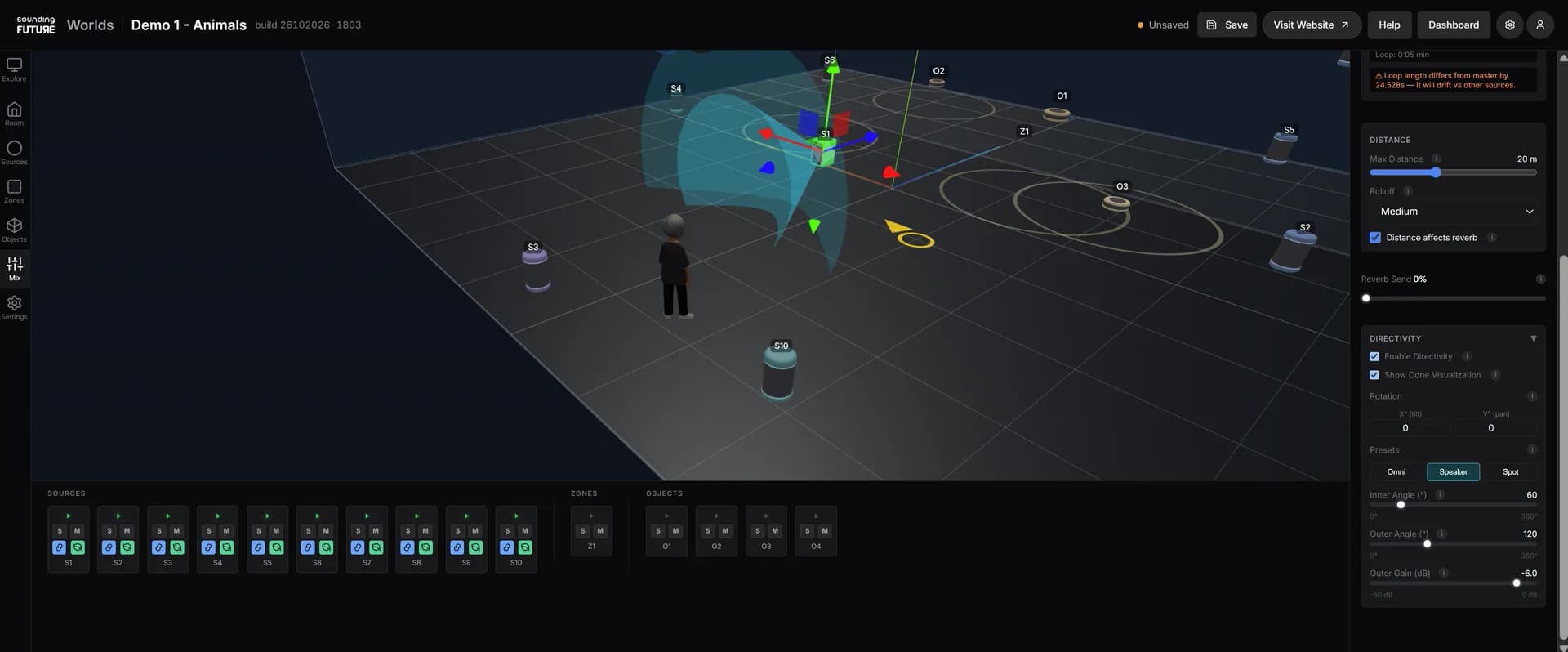
Sound sources with plausible distance and directivity — radiating 360° or in a focused cone, like a loudspeaker.
Area
Sound beds that fill a region. Enter and the sound fades in; leave and it fades out. Zones can overlap; a set priority decides which one you hear.
Trigger
Visible or invisible triggers: approach one and a sound starts, a text appears, a change unfolds.
In the browser
Rooms
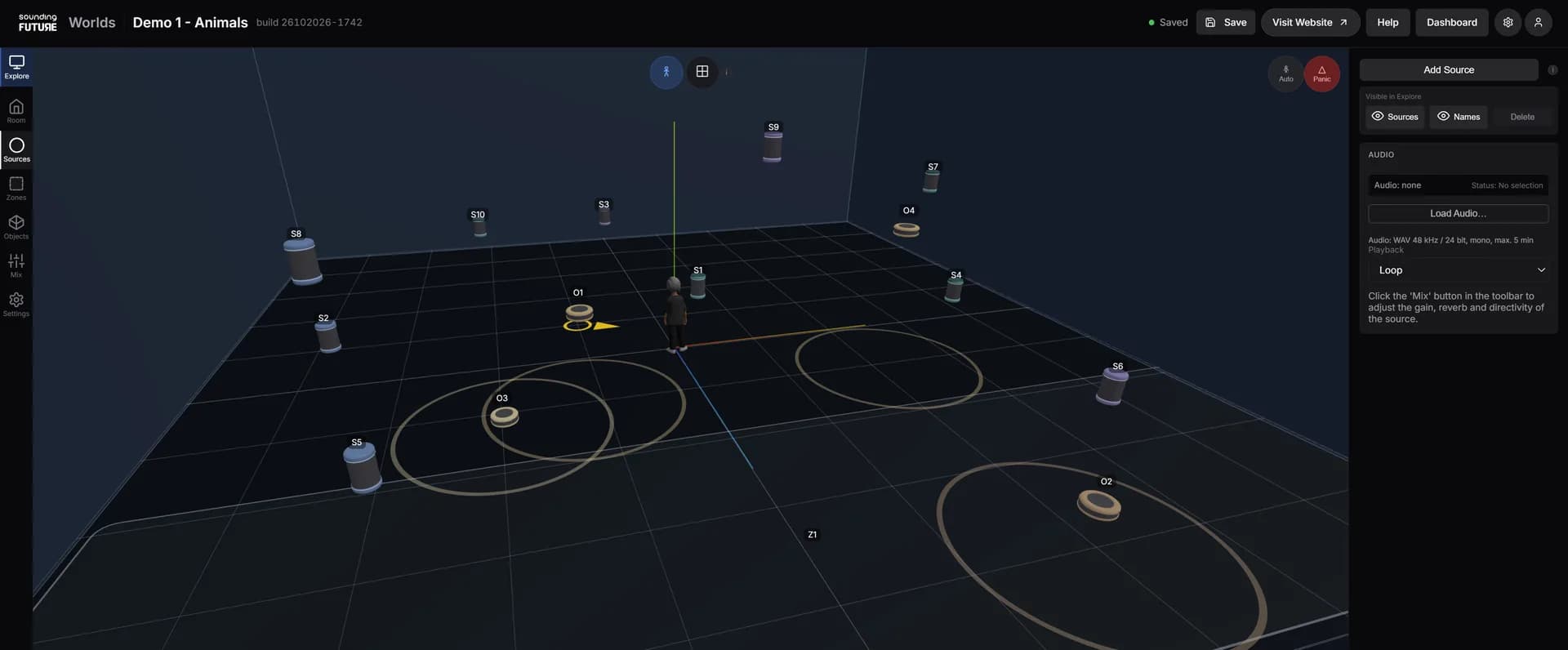
Start with a neutral geometric space, upload your own 3D model, or use a 360° photo as a photorealistic backdrop — recreate a real place, or build one that couldn't exist.
Perspectives
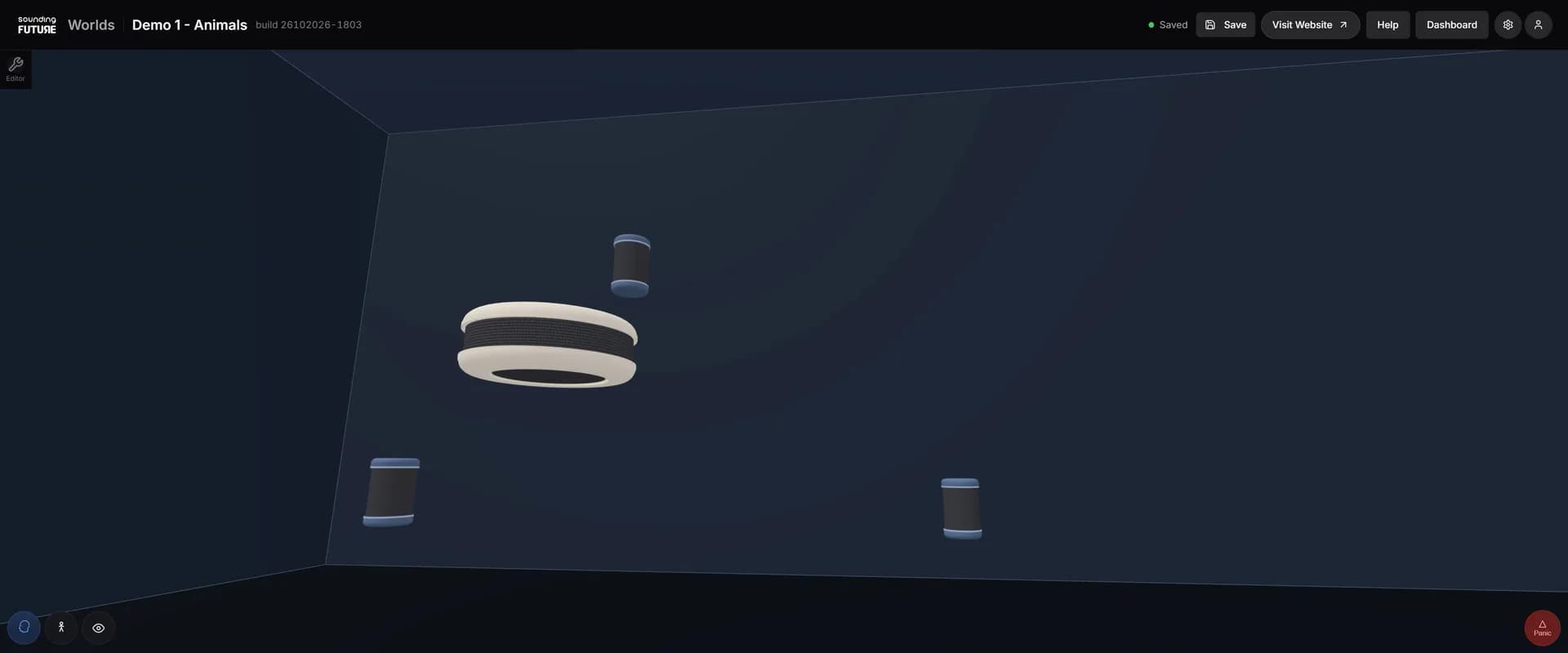
Bird's-eye view for placement, third-person for overview, first-person to walk through as visitors will. In explore mode the tools disappear and only the world remains.
Mixer & sync
Every source, zone and world object gets its own channel with mute, solo, level and reverb send. Sync sources to a shared clock, so a multichannel piece plays as one coherent work.
What Worlds is for
01
You don't record a walk-through installation — you rebuild it.
Free position and duration stay intact — the work remains walkable online long after the exhibition closes.
02
Vast rooms, dozens of simultaneous sources, impossible architectures — a venue that exists only online.
03
Recreate the courtyard, gallery or hall where a work will stand and hear it on screen before a single loudspeaker is placed.
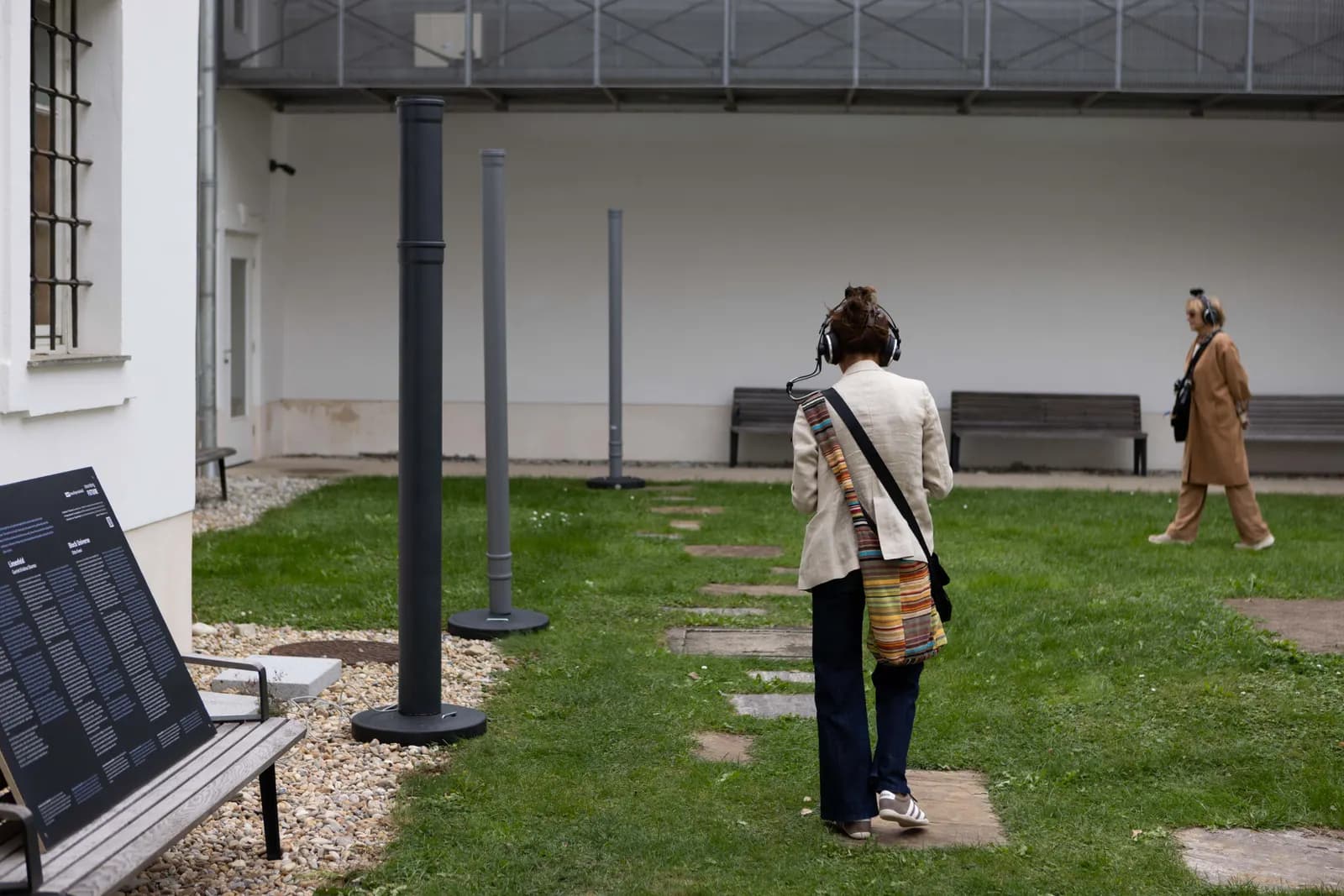
8–11 October 2026 · Volkskundemuseum Graz
Visitors walked the museum courtyard with headphones, tracked in space, hearing the sound change with every step and every turn of the head.
See the Graz worlds →FAQ
Headphones and a current browser. Worlds works on desktop, phone and tablet: on a computer you move with WASD, on a phone or tablet with an on-screen joystick. Nothing to install.
Anyone can walk through the published worlds — no account needed. Building your own world is opening in stages: we're onboarding composers, curators and institutions step by step via the waitlist. Tell us who you are and what you'd like to build.
No. Worlds runs entirely in the browser — nothing to install, no code to write. You place sounds in 3D space by dragging them where they belong; the complexity of spatial audio and binaural rendering stays beneath the surface.
Worlds is built on the web audio engine by atmoky, a Graz-based company with roots at the Institute of Electronic Music and Acoustics (IEM). It renders binaurally in the browser: sources stay anchored as you move and turn, and loudness falls off plausibly with distance.
Yes. In October 2026 three worlds built with Worlds became a walkable headphone installation in the courtyard of the Volkskundemuseum Graz, with visitors tracked in the space. If your institution is interested in a similar project, get in touch via the waitlist.
Early access
Worlds is opening in stages, developed hands-on with composers and curators. Join the waitlist for updates and early access. Festivals, museums, universities and galleries: tell us about your project and we'll be in touch directly.
Who we're onboarding
One or two emails at most — updates on the beta and early-access invitations. No spam, unsubscribe anytime.